Fruit 2048 turns the classic number-merging puzzle into a fruit-stacking test of patience and pattern reading. Every swipe pushes lemons, oranges, and pineapples across a tight grid, and matching pairs snap together into the next fruit up the chain. That single merge idea drives the whole game — easy to pick up, tough to walk away from once your board starts filling with bigger produce.
The setup stays simple on purpose. You get a small board, a handful of directions to push, and one goal: keep merging before space runs out. Nothing about the rules feels complicated, but the pressure builds fast once your grid gets crowded. Start playing Fruit 2048 now and you will feel that pressure within the first few moves.
This build runs as a lightweight HTML5 title, so you can play Fruit 2048 online without installing anything. It loads straight into your browser tab and responds instantly whether you tap, click, or press a key. The rest of this guide walks through how the grid behaves, how fruits climb in value, and what actually ends a run.
Fruit 2048 Grid Mechanics and Movement
The 4x4 Board Structure
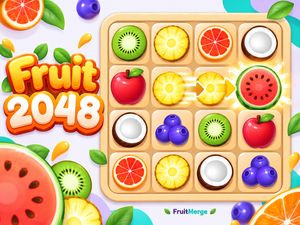
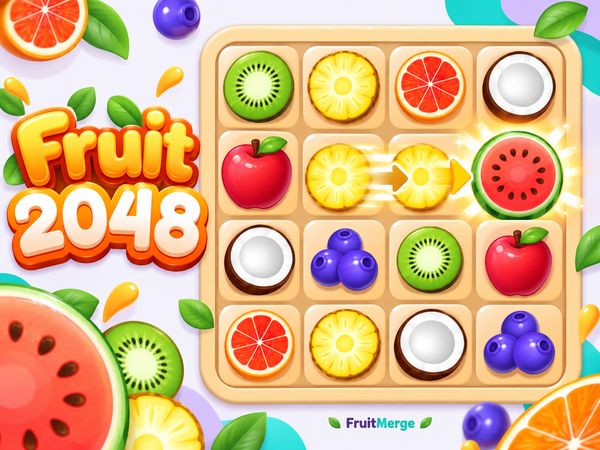
Fruit 2048 sits on a 4x4 grid, sixteen cells total, arranged in a square you can scan at a glance. Each cell either holds a fruit or sits empty, and that balance between full and open space is the entire game. You never move a single tile on its own. Instead, every fruit on the board slides at the same time, in whichever direction you choose.
Push up, and every tile climbs as far as it can. Push left, and the whole row shifts toward the wall. Tiles stop only when they hit the edge of the board or run into another fruit that cannot merge with them. That creates a kind of chain reaction across the grid — one swipe can rearrange the entire layout in a heartbeat.
Because the board is small, every open cell matters. A crowded 4x4 grid leaves you little room to maneuver, so reading the board before you swipe becomes a habit fast. Watching how tiles will land, not just where they start, is what separates a controlled run from a rushed one.
Tile Merging Rules
Merging is the reward for lining up matching fruit. When two identical tiles slide into each other, they combine into a single fruit worth double the value. A pair of lemons becomes one bigger lemon-tier fruit, and that new tile keeps its spot on the board. Merges only happen between fruits of the same kind — nothing else touches or combines.
This rule is what makes direction choice matter. One swipe might merge three pairs at once if the board lines up right. Miss that alignment, and you just shuffled fruit around without gaining anything.
Scoring and Win Conditions
Reaching the Top Tier Fruit
Your score climbs with every merge, since each combined fruit carries double the value of the pair that made it. Small merges add up quickly, but the biggest score jumps come from combining your highest-tier fruits together. That is why protecting a strong fruit in one corner pays off — it is usually the difference between a modest score and a genuinely high one.
Fruit 2048 does not force a hard stop once you hit its top-tier fruit. Play continues past that point as long as legal moves remain on the board. That means reaching the top fruit is a milestone, not a finish line. You can keep merging afterward, stacking more value on top of what you already built, right up until the grid stops giving you room to move.
Loss Conditions and Recovery
A run ends the moment the board fills completely and no merge is possible anywhere on the grid. Every cell holds a fruit, none of them match a neighbor, and no swipe changes anything. That is the only way Fruit 2048 closes out a run. When it happens, your best move is simple: start a fresh board and apply what that last run taught you about spacing and timing.
Control Systems Across Desktop and Mobile
Keyboard Arrow Execution
On desktop, the arrow keys handle every move. Press up, down, left, or right, and the entire board shifts in that direction at once. There is no separate key for individual tiles — one press moves everything that can legally move. This makes the keyboard the fastest way to play, since you can react to a changing board with a single tap instead of a drag motion.
Because every fruit shifts together, timing your presses matters more than speed alone. Rapid, careless key presses can waste a good setup just as easily as a slow, deliberate one builds it. Many players rest their fingers directly on the arrow cluster so they can react the instant a merge opportunity appears on the grid.
Touch and Mouse Gestures
On touch devices, a simple drag replaces the key press. Swipe in any direction and every tile on the board slides that way, just like the keyboard version. Desktop browsers that support it also let you hold the left mouse button and drag to swipe, giving mouse users the same control without needing a keyboard nearby.
Fruit 2048 Variations and Related Formats
Grid Sliding vs Drop Styles
Lemons, oranges, and pineapples replace the numbers you might recognize from other tile puzzles, but the movement rules underneath stay the same.
This sliding format is distinct from drop-style puzzle games, where pieces fall into place rather than shift across a fixed grid. Fruit 2048 sticks entirely to the sliding model. If you enjoy this kind of grid logic, the wider Puzzle collection has more titles built around similar tile-matching ideas.
Cross-Platform Availability
✨ Key Features of Fruit 2048
- Vibrant fruit graphics replacing standard numbers
- Classic 4x4 sliding-tile puzzle framework
- Lightweight HTML5 browser performance across desktop and mobile devices
How to Play Fruit 2048
Step 1: Use the game controls
Use Arrow Keys to slide all tiles on the board in the chosen direction. Use Left Mouse Button to drag to swipe on supported desktop browsers. Use Drag to slide all tiles in the swiped direction on touch devices.
Step 2: Survey the Initial Fruit Layout
Inspect the initial tiles spawned on the board to locate matching fruit pairs.
Step 3: Choose an Anchor Corner
Select one corner of the board to host your highest-value evolving fruit tile.
Step 4: Slide Tiles in Cardinal Directions
Use the arrow keys or swipe gestures to push tiles toward your chosen anchor edge.
Step 5: Combine Matching Fruit Pairs
Collide identical produce tiles together to evolve them into larger, higher-value fruits.
Step 6: Clear Space and Prevent Board Lockout
Keep open slots available for newly spawning fruit tiles to avoid running out of moves.
Fruit 2048 FAQs
What are the basic controls for Fruit 2048?
Browser keyboard: Arrow Keys — slide all tiles on the board in the chosen direction. Browser mouse: Left Mouse Button — drag to swipe on supported desktop browsers. Mobile: Drag — slide all tiles in the swiped direction on touch devices.
Can I play Fruit 2048 on mobile devices?
Yes. Fruit 2048 runs in your phone or tablet browser, and it has touch controls. There is also a mobile app.
Do I need to download Fruit 2048?
No. Fruit 2048 runs in your browser on this page, with nothing to download or install.
Conclusion
Fruit 2048 delivers a fresh, fruity twist on the classic tile-matching puzzle formula, built in HTML5 so it runs smoothly right in your browser. Sliding all tiles across the board with simple arrow key presses, mouse drags, or touch swipes makes it instantly approachable, whether you're playing on desktop or mobile.
Its charm lies in that simplicity: a singleplayer experience with no clutter, just clean sliding mechanics and satisfying tile movement that keeps you coming back for another round. It's the kind of game you can pick up in seconds but find hard to put down.
Ready to slide, swipe, and see how far you can go? Play Fruit 2048 right here on this page and start your puzzle session now.

No comments yet. Be the first to share your thoughts!